Tag Archives: science

So Cool At COSI

Standard
So Cool At COSI

Howdy! This past week, I took a trip to COSI which is a really cool interactive science museum in Columbus. It features exhibits that wow children and adults alike that include a trip to outer space, a dive under the sea, walking with the dinosaurs, and so much more. COSI also has pop up exhibits that change throughout the year and I was able to see an amazing section on sharks just in time before its removal on September first. This museum is so educational but extremely cool and it makes learning something new feel like play. Such a great way to spend an afternoon! Check it out:

Wayyyyyyy back in eighth grade, my class took a trip to COSI and I will never forget being so awestruck by the Ocean exhibit and my sentiments remain the same. As you walk through the hallway leading up to it, you can literally smell the chlorine and you just know you are in for something awesome! Entering the Ocean portion of COSI is like walking through a sunken ship and you can go one of two ways. Your first option is to visit a submarine headquarters where you can play games that allow you to control a submarine and explore the depths of the ocean. The second way to go, though, is truly the piece de resistance.

Option number two leads you into King Triton’s cavern and it is seriously breathtaking. From floor to ceiling is a huge statue of King Triton in a fountain that lets you control the water. It is just so spectacular and I could have stood there looking at it all day. Throughout the glistening cavern are different interactive activities that explore the movement and sound of water. You can balance balls on the tiniest geysers, make waves, create your own flow of water through pipes, and my personal favorite: The water bell. The water bell is a flow of cascading water that looks like… a bell lol. The cool thing is that after you put your hand through the bell, it no longer gets wet. My mind was blown!

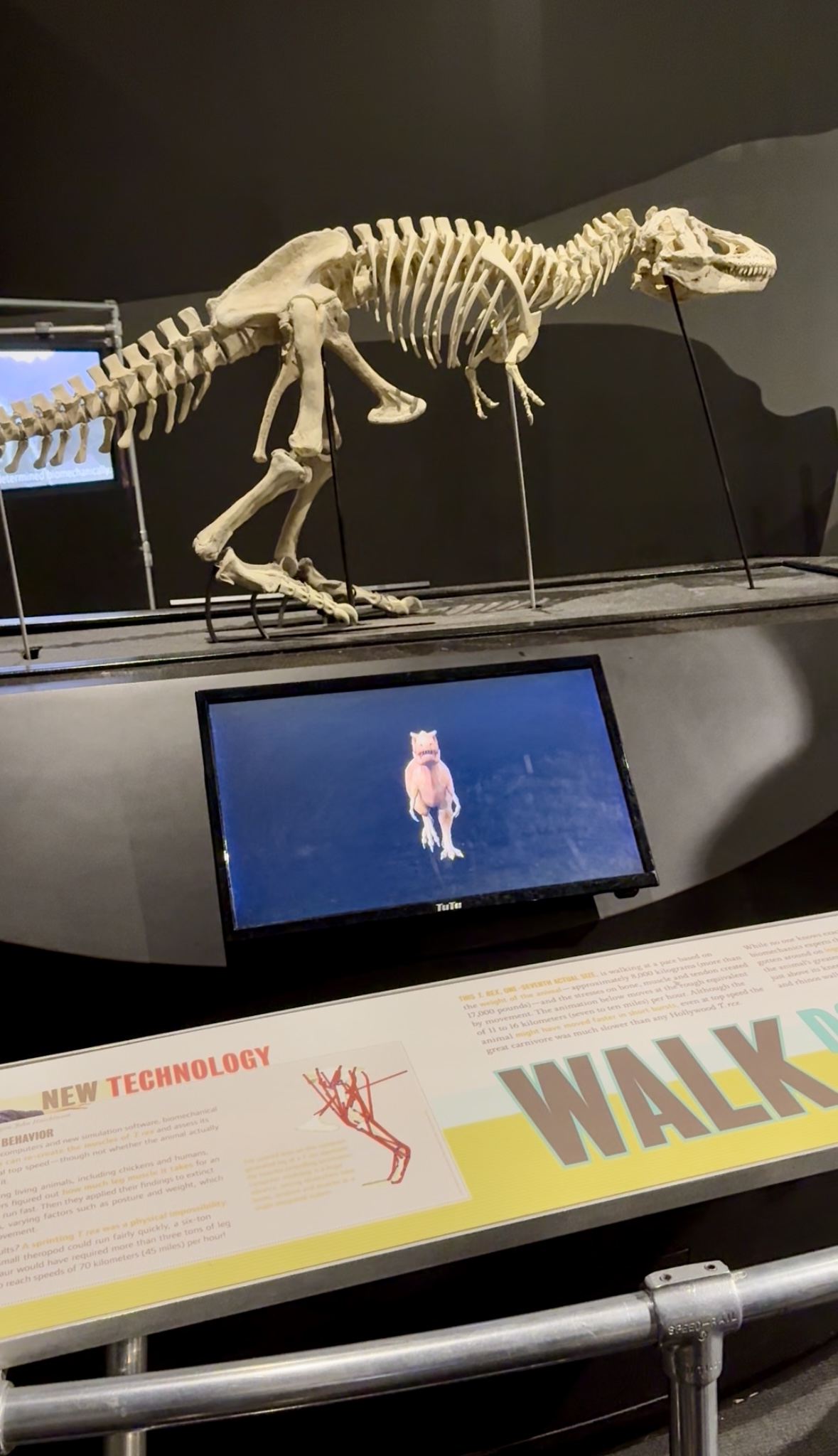
Another major highlight of the trip was the dinosaur exhibit that reminds me so much of the Animal Crossing museum! The dino display is gigantic and showcases to scale dinosaur skeletons, fossils, eggs, feathers, footprints, and anything dinosaur related you can possibly think of. The dinosaur exhibit also features a portion specific to the relation of dinosaurs and birds as well as under the sea creatures. It explores taking flight, motion, hide or feathers, and skeletal structure. It was incredibly interesting and the similarities felt so obvious after all of it was laid out before you. I also really appreciated the way the explanations at COSI were written. While all of the information you see has scientific terms, the signage breaks it down into plain speak so you can fully grasp everything. I certainly learned a lot from all of the literature in each exhibit.

My final favorite part of COSI was an exhibit simply entitled Progress. I also remember this one from my eighth grade field trip! As you enter Progress, you step back in time to a bustling street in 1898. You can see all of the latest technology of the time like old fashioned cameras, telegram machines, and telephones as well as all of the different shops including an apothecary, general store, and hardware store. Once you are ready to time travel again, you leave 1898 and revisit the same street in 1962. My, how the times have changed!

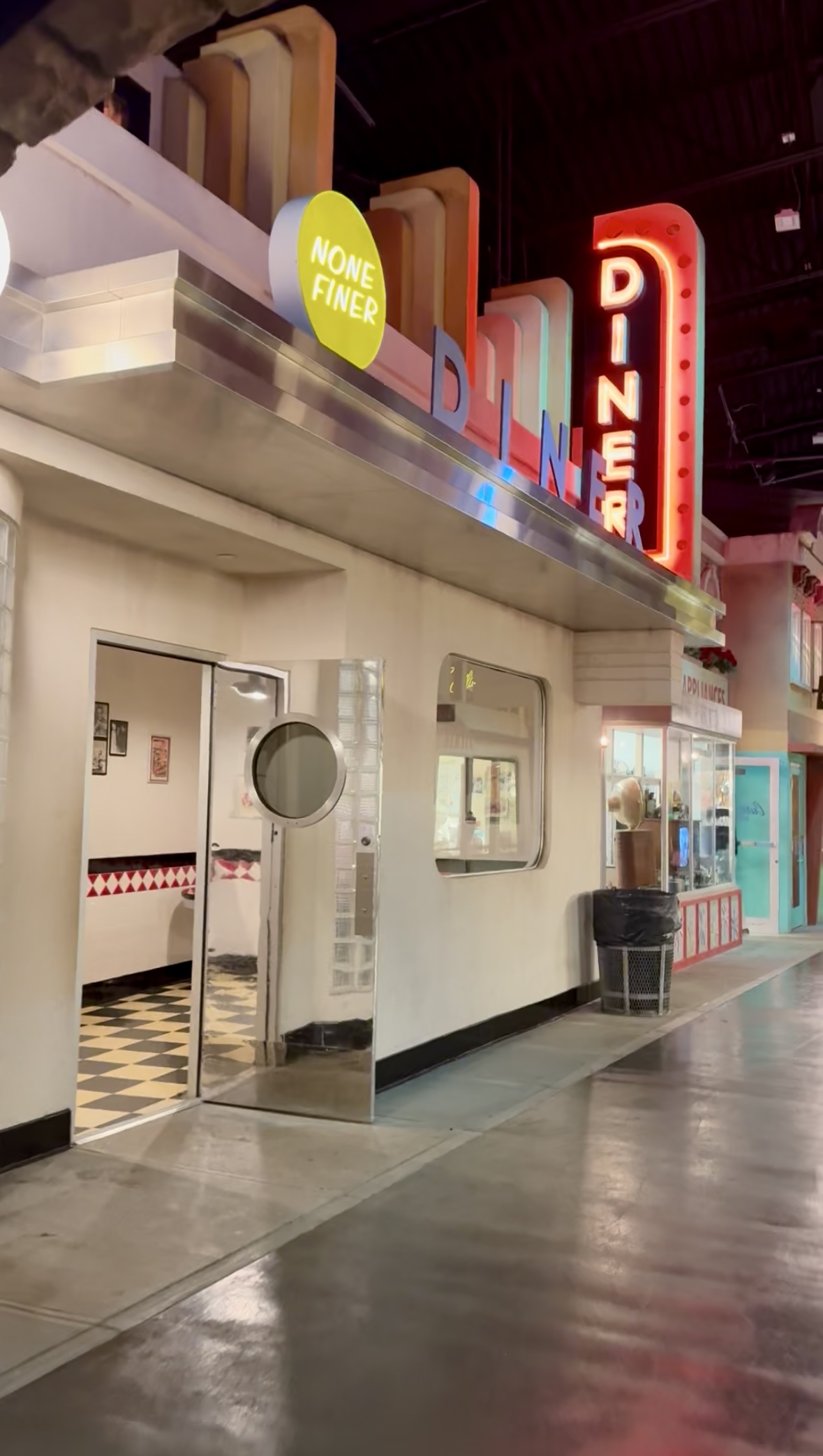
In 1962, the street has completely transformed. There is a retro diner, a radio station, news station, and telephone booth. You can see vintage toys and games, food staples, magazines, and even an old time rocket ride outside of the toy store. My favorite part of 1962 was the appliance store because I absolutely love that style. There were funky refrigerators, blenders, radios, and huge box televisions. What a far cry from 1898!

What a fun little road trip to COSI. I can’t recommend it enough if you are in the area!

Do you have a museum similar to COSI in your neck of the woods? What is your favorite thing to learn about? I want to hear from all of you, so leave me a comment and let’s chat! Much love. -Sarah


Are You A Science Person?

Standard
Are You A Science Person?

The power of narrative in our lives is quite extraordinary. For instance, have you ever heard somebody say that they’re not “a cat person?” On the face of it, it seems like they’re saying that they don’t like cats. But when you dig a little deeper, it turns out that they are trying to describe their minds to you. “Cat person” has all sorts of connotations that go well beyond traditional preferences.

The same goes for when people say that they’re “practical,” “analytical,” or “intellectual.” It’s more about their identity than any particular facts of the matter. But here’s an annoying truth: we’re all general-purpose thinking machines. A human can do an enormous variety of tasks, from change a nappy to write a symphony. And this suggests that we’re harder to typecast than we imagine.

It’s just not true, for instance, to say that certain people are “social people” or “spiritual people”. We all have these capacities so long as we allow ourselves to access them. Let’s take a look at another example:

Are you a science person?

Nowhere is this mode of thinking more evident than when people talk about the type of academic they are. From an early age, students get the sense that they are “artistic” or “scientific,” and then they tend to run with it for the rest of their lives.

How many times have you heard people say, “I was never good at science at school”? Usually, this isn’t just a statement of fact, but also one of mind. The person saying it genuinely believes that there is some defect in their brain that gets in the way of their understanding of the material, preventing them from ever exploring it fully.

There’s probably no fundamental reason why they couldn’t complete a master of science in engineering management or a foundational physics degree. It’s just that they have this belief that they can’t. It becomes a part of their identity.

These kinds of thoughts are painfully self-limiting. People who engage in them are denying themselves valuable experiences and education that they could have. For instance, learning about engineering could provide them with the skills to figure out whether a project is viable or not. Learning chemistry and biology could help you with environmental projects, like changing single-use plastics to biodegradable SciQuip gloves. Knowing about mathematics could allow them to understand scientific papers or other insights from the academic literature and so on and so forth.

Typecasting people is generally a bad idea. But doing it to yourself is arguably worse because you’re placing arbitrary limits on what you can do. If you don’t believe you can do science, you’ll never get into the science field, and you’ll never get to experience that aspect of life. And that’s a shame.

Pexels Image

Perhaps there are brain differences between people who are great at science and those who aren’t. Maybe Einstein really did have more grey matter between his ears to solve complex problems than the rest of us. But that doesn’t mean that the science parts of your mind are somehow atrophied compared to the norm. Just like everything in life, doing great science requires practice.

Featured Image By: Pexels

Science Backed Ways To Give The Best Gifts

Standard
Science Backed Ways To Give The Best Gifts

Choosing a gift that the recipient will truly love and appreciate can be no easy feat. Even if you know someone very well, it’s so easy to get it wrong and give them a gift that, sure, they’ll pretend to love, but which you just know they’re disappointed in. The good news is, is that it doesn’t have to be that way – science has come to the rescue.

Yes, scientists have looked into the art of gift giving and they have come up with some solid rules for giving gifts that will be really appreciated by anyone on any occasion. Read on to find out more:

Know the Person Well:

Okay, so this probably isn’t going to help you if you’re buying for a mere acquaintance but a psychologist at San Fransisco State University by the name of Ryan Howell says that really knowing the person you’re gifting to is the key to getting it right. This makes sense, because if you know that your friend is a fan of the kind of quirky gifts you find at Davson Sales or you know that your aunt loves the dresses at Macy’s, then you’ll be giving a great gift. Even better, it enables you to go with a meaningful gift that is highly personalized to them and is unique – how could they not love that?

Make a Donation:

Although this often seems like a way of wimping out or something that people will pretend to like, but are secretly disappointed about, science says differently. In research conducted by Harvard Business School, it was found that giving to charity makes people happier than buying stuff and giving more makes people happier still, so by making a charity donation in the giftee’s name, you both win.

Handmade:

Buying something brand new from the store can be a good move if you know for sure that the giftee wants whatever it is you’re buying, but if you don’t it can be a minefield. Will they like it? Do they already have it? Should I give them the receipt just in case? Luckily, you can easily avoid all of that, because a study conducted by the Journal of Marketing in 2015 found that people like to gift homemade items because they are more unique, thoughtful, and they are often more appreciated. The same is true of family heirlooms which are more valued and, thus, more appreciated even if they are not actually more expensive.

present1

A craft that you enjoy making is always a good idea!

Give Them an Experience:

Giving people an experience that they will remember forever as gifts, like the ones at If Only, typically, according to science, makes them happier than giving them objects that they may well be bored of in a month or two. So, if you’re stuck, think about whether they’d like tickets to the big football game, a skydiving experience, a spa break, or something similarly exciting that fits their personality. They’ll undoubtedly like it more than chocolates, beer, or flowers.

Even if you weren’t great at science in school, let the experts help you make the best of your gifting with the ideas above!

Featured Image By: Pixabay

Dear College Self,

Standard
Dear College Self,

Hey everyone and happy Thursday! As a fairly recent college grad (Winter of 2016, baby!), I find myself missing my Alma Mater constantly. Cuyahoga Community College, AKA Tri-C, is where I obtained my Associate of Arts and I am so thankful for all of the wonderful teachers that I encountered who helped me achieve graduating Magna Cum Laude (woo!). And the students weren’t so bad, either! I am always playing around with the idea of going back to school because I loved it so much but there are definitely some things that I would do differently this time around if I go back for my Associate of Science in the future – like the following:

Dear College Self,

First, let me repeat for the millionth time that there is no shame in waiting to go to school like I did. Thanks to my two year hiatus after high school, I was able to build up my bank account while climbing the corporate ladder at my job. I also realized after a four year stint at the same place that working in the mall for the rest of my life definitely isn’t for me (Not that there’s anything wrong with that.)!

After feeling unbearably stuck in life and at work, I decided to take a huge leap of faith and started classes at Tri-C as well as creating lifewithlilred. And you know what? College wasn’t as bad as I thought it would be! And by “wasn’t as bad”, I mean it really wasn’t bad at all. Being in a classroom, whether it be in real life or online, was definitely a change of pace but it was a welcomed one. Using my brain to solve adult problems felt so good after years of monotony and a zest for learning, which was nonexistent in high school, seemed to appear over night. Like I said, it was an exciting change of pace!

Despite an overwhelmingly amazing college experience, there are always things that you wish you would have done differently. Starting college a little later in the game made me hesitant to try new things on campus. Different clubs, events, and programs were constantly going on throughout the week and I never made one cameo appearance at any of them. The sad thing is, is that Tri-C is a place for people of literally all ages (from 16 to 90!), and my discomfort in my situation never allowed me to fully embrace what a unique community that Tri-C is. This is definitely something that needs to change when I eventually go back for my Associate of Science and I am committed to becoming more involved during my next go around.

And, of course, this is the generic “what I wish I did differently response” but I really do wish that my college self would have studied just a little bit harder. Not really knowing about graduating with honors until the literal day of graduation was a mistake on my part. How does someone not know about the world of Cum Laude if they’re in college? Lol, I’m not sure. Probably because even when I started classes at Tri-C, I wasn’t focused on the end goal and that was another major mistake. Had I known that I was devastatingly close to graduating Summa Cum Laude, I would have pushed and applied myself way harder to achieve that honor. But hey, there’s always next time – right?!

Although there are things that I wish I could redo about my college experience, I still graduated with flying colors and finally took an interest in becoming a more educated and well rounded individual. That makes me incredibly proud of my college self and I’m looking forward to applying an even more studious and adventurous spirit to college life if I go back to school again.

graduationpic1graduate2

What advice would you give to your college self? What would your advice be to college students right now? I want to hear from all of you, so leave me a comment and let’s chat! Much love. -Sarah

Should You Major In Liberal Arts Or STEM?

Standard
Should You Major In Liberal Arts Or STEM?

There was a time, perhaps a couple of decades ago, where the liberal arts – a.k.a. the humanities, dealing with the study of literature, history, philosophy, art, and the like – and STEM fields (science, technology, engineering, and mathematics) worked together in harmony. These days, there seems to be a major divide between the two when it comes to college. At least, that’s what a lot of commentators and even politicians believe.

Back in 2014, Barack Obama called into question the usefulness of a liberal arts degree. He caught quite a bit of heat for suggesting that a degree in art history may not provide you with the job opportunities that an education in trade and manufacturing will. Oddly enough, this actually put him on common ground with the Republicans, who have long questioned the usefulness of degrees such as literature and anthropology!

stem1

He didn’t always please the liberals!

But how right are the critics of an education in liberal arts? Before people even get an opportunity to ask “How do you get a bachelor’s degree?”, they seem to be hounded by such a question. If you feel a bit torn and confused about the whole thing, here are a few points that you should keep in mind:

Manufacturing and Trade Aren’t Dead: So many people out there seem to think that we’ve moved past the need to have so many students doing STEM subjects because there isn’t much career potential in manufacturing and trade. Here’s the thing: Obama wasn’t actually so much criticizing liberal arts as he was criticizing this idea. The fact is, that these are still essential fields in our economies, and fulfilling and lucrative careers are still common in those fields. Don’t dismiss manufacturing and trade as dead fields because they are very much alive and kicking if you know where to look.

Liberal Arts Education Isn’t Just “Training for Starbucks”: An education in the humanities does not doom you to a dead-end job, the way that a lot of people tend to dismiss it. Having said that, there are certainly courses out there that are so steeped in postmodernist denials of reality or objective truth and so much closer to ideological indoctrination rather than education that job prospects after graduation are genuinely lackluster.

But, a degree in philosophy has been shown to get people into well-salaried positions. In fact, the average philosophy major earns more than the average accounting major. As for an English degree, so often mocked by humanities haters, it’s a massive boost for many careers due to the degree showing your ability to read and analyze deeply. Talent in theory and criticism is more useful in business and technology fields than you may think! You can also combine philosophy with technology with a NU London Philosophy and AI Masters degree. This offers the best of both worlds in creative thinking and analyzing the constant changes in our increasingly technological world.

stem2

Starbucks & studies!

And Remember: while Bill Gates has dismissed liberal arts degrees, Steve Jobs has pointed out that his company would never work it if hadn’t been a perfect marriage of STEM and liberal arts.

stem3

Take that, Bill Gates!

Remember Part 2: the value of a degree is both overestimated and underrated – it’s the former in a more general sense, but the latter when you take into account oft-disparaged subjects such as those you’ll find in the humanities. At the end of the day, higher education isn’t pointless, nor is it a waste of time – as long as you pursue your education with purpose, you’ll get something out of it.

Featured Image By: Wikimedia